
A layered framework
Chenile is organized as layers that build on one another. Each layer is a set of repositories with a clear job.
Layer 1 — Build and version baseline
chenile-parent is the Maven super-parent for the whole ecosystem. It inherits from Spring Boot and centralizes the Java version, Spring Boot version, library and plugin versions, and every Chenile artifact version. It is the first repository upgraded and published in a release; downstream repositories inherit properties such as chenile.core.version, chenile.security.version and chenile.messaging.version.
Layer 2 — Core runtime
chenile-core is the substrate everything else builds on. Its concerns are:
- normalizing every request or event into a
ChenileExchange, - executing that exchange through an interceptor and orchestration pipeline,
- loading service and operation definitions,
- HTTP adaptation, state-machine (STM) support, and persistence/utility helpers,
- a multi-version metadata model that aggregates every classpath
*version.txtinto a version map so each service reports its own version.
This pipeline is the mechanism behind the whole policy story — interceptors are your policies.
Layer 3 — Application blueprints
chenile-query-workflow-blueprints and chenile-process-management encode higher-level patterns: metadata-driven query services (MyBatis), workflow-enabled services built on Chenile STM, and long-running process orchestration with sub-process tracking.
Layer 4 — Integration capabilities
chenile-service-registry, chenile-proxies, chenile-security and chenile-messaging provide the capabilities around service interaction: the registry that binds policies to operations, interface-based proxies for local and remote calls, the contract-first auth framework (auth-server, gateway, resource-server), and messaging/pub-sub integrations.
Layer 5 — Testing, auxiliary and configuration
chenile-bdd supplies Cucumber-based integration testing; chenile-others adds file-watch, a Kubernetes-aware scheduler, cache and the config maven plugin; cconfig supplies modular runtime configuration the rest of the stack can consume.
The runtime model in one picture
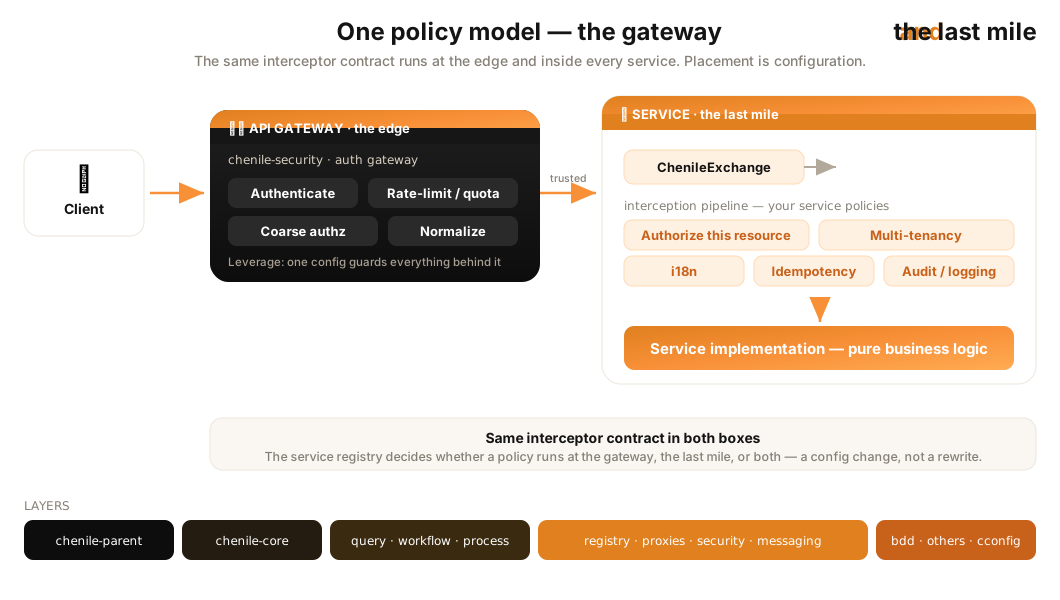
The same exchange-and-pipeline model runs inside the auth gateway and inside each service, which is what lets a single policy abstraction serve both the edge and the last mile. A request is normalized into a ChenileExchange, run through the interception pipeline (your service policies — security, tenancy, i18n, logging), reaches the pure business logic, and returns back out through the same pipeline.
The PlantUML source for this diagram is included in the site under
diagrams/chenile-architecture.puml.
Dependency direction
Dependencies always point toward abstractions: consumers depend on *-api modules, never on *-service modules. Repositories are versioned together through chenile-parent and are currently aligned on v2.1.31.