
The mirror image of the last mile
Everything so far has been about the server side of a call — the pipeline that runs around a service implementation. But a service is also a client of other services, and the outbound side deserves the same treatment: you shouldn’t hand-write transport code, and cross-cutting concerns shouldn’t be sprinkled into caller logic.
Chenile provides two pieces that make this work together: its own service registry and a proxy framework with client-side interception.
Chenile ships its own service registry
chenile-service-registry holds the metadata needed to find and invoke a service: remote service definitions, their operations, and each operation’s parameters (ChenileRemoteServiceDefinition, ChenileRemoteOperationDefinition, ChenileRemoteParamDefinition). It is:
- DB-backed with its own controller and repository, so definitions can be managed and evolve;
- cached (
ServiceRegistryCache) and fingerprinted (ServiceRegistryFingerprint) so clients detect changes efficiently; - reachable through a delegate (
service-registry-delegate·ServiceRegistryClientImpl) that lets a client pull a remote service’s definitions.
This is the same registry that carries a service’s policy configuration — so “how to reach a service” and “what policies apply to it” live in one place.
Controlling what gets published 2.1.31
Not every service belongs in the catalogue. Publication can be switched off per service or for a whole deployable:
@ChenileController(registerInServiceRegistry = false)keeps one service fully wired locally (pipeline, health check, proxies in the same JVM) but never publishes it — see annotation-based services.chenile.service.registry.read-only=truemakes a deployable a pure consumer: it still reads definitions and loads its local cache, but neither publishes at startup nor lets delegatesave(...)calls reach the registry.
The proxy framework: call the interface, not the wire
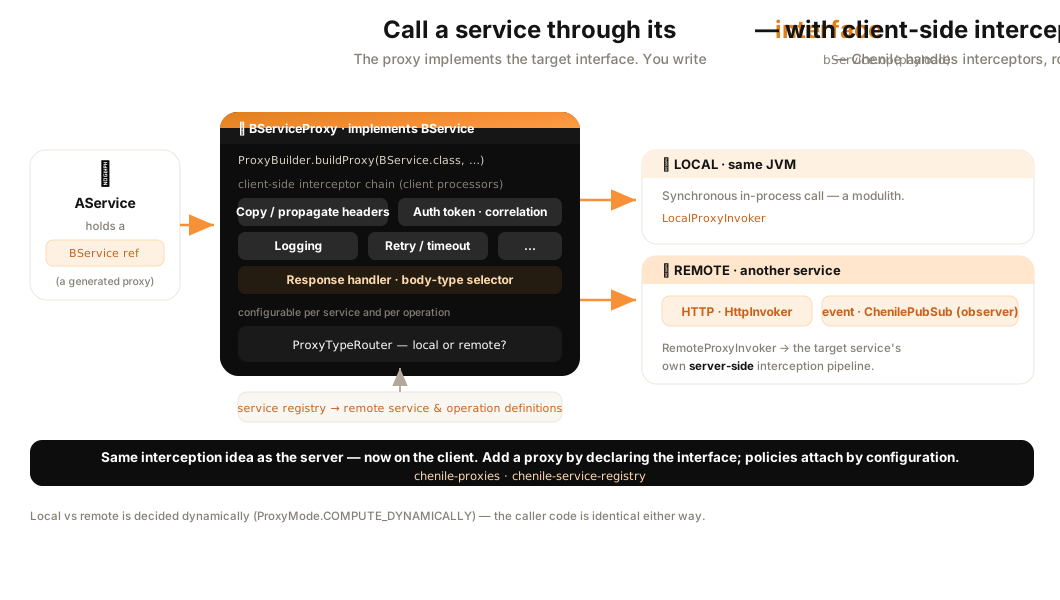
The proxy framework (chenile-proxies) lets one service invoke another through its Java interface, with no hand-written transport. You ask Chenile for a proxy of the target interface and just call its methods:
// Build once — a proxy that implements the target service interface
BService bService = proxyBuilder.buildProxy(
        BService.class, "bService", headerCopier /*, ProxyMode */);

// Call it like a local object — Chenile does the rest
BResponse r = bService.op(payload);
The returned object implements BService, so the caller is completely insulated from transport. HeaderCopier propagates the relevant headers from the current request outward (correlation, identity, tenant), so context flows across the call.
Local or remote — decided dynamically, seamlessly
A ProxyTypeRouter decides whether the call is local or remote — and the caller code is identical either way:
- Local (
LocalProxyInvoker) — if the target is in the same JVM, the proxy makes a direct, synchronous in-process call. This is what lets a modulith work: services call each other through proxies today, and can be split apart tomorrow. - Remote (
RemoteProxyInvoker) — if the target is another service, the proxy invokes it over HTTP (HttpInvoker), or, for the observer/event style, publishes an event viaChenilePubSub(the messaging layer — Kafka, MQTT, etc.). The routing uses the registry’s definitions to know how to reach it.
Because placement is dynamic (ProxyMode.COMPUTE_DYNAMICALLY), adding a service proxy on the client side is seamless: you declare the interface and ask for a proxy; whether the callee is co-located or across the network is a deployment concern, not a code change.
Client-side interception
Here is the part that mirrors the server. On the way out, the proxy runs a client-side interceptor chain — Chenile calls these client processors — against a RemoteChenileExchange. Just like server-side interceptors implement service policies, client processors implement outbound policies:
- copy and propagate headers, attach the auth token and correlation ID;
- logging of the outbound call;
- retry / timeout behaviour;
- response handling —
ChenileResponseHandlerand aResponseBodyTypeSelectorturn the raw response back into typed objects and surface errors consistently.
Crucially, this chain is configurable per service and per operation — ServiceSpecificClientProcessorsInterpolation and OperationSpecificClientProcessorsInterpolation interpolate the right processors for the specific call. So you can add a retry policy to one operation, or an extra header to one service, purely by configuration.
org.chenile.proxy.builder.ProxyBuilder, invoker.ProxyTypeRouter, LocalProxyInvoker / RemoteProxyInvoker, interceptors.HttpInvoker, ChenileResponseHandler, and the client-processor interpolations. Registry: ChenileRemoteServiceDefinition, ServiceRegistryService, ServiceRegistryClientImpl. Ships in chenile-proxies and chenile-service-registry.